
I consolidated my 9 years of experience in marketing into one article
Everything I learned in 9 years of buying ads, in one place: the goal first, one deep audit, follow the money, Shopify as the truth, and what I do every morning.
On this page
- The short version
- 1. Everything starts with the goal
- 2. Learn the story of the account, once
- 3. Follow the money
- 4. Shopify is the truth
- 5. New customers, without Meta’s breakdown
- 6. The click window does two jobs
- 7. The daily loop: push, hold, cut
- 8. Keep the account simple and boring
- 9. Pay more for better customers
- 10. How I test
- 11. Offer first, then the page, then the creative
- 12. What I ignore
- 13. The mistakes I keep seeing in bigger accounts
- 14. If you want an AI agent to do this
- 15. Where this can go wrong
I’ve been buying ads for 9 years now. Mostly Meta, mostly for DTC brands.
This spring a friend of mine who builds AI agents wanted an agent that buys ads the way I do. So we spent hours on calls and on WhatsApp, and I walked him through how I think about every account. His agents turned all of it into one long document.
When I read it, I was like… ok, that’s pretty much everything I know.
So I checked it against the call recordings, took out every brand name and rewrote it in my own words.
This is it. It’s long, so save it for later.
The short version
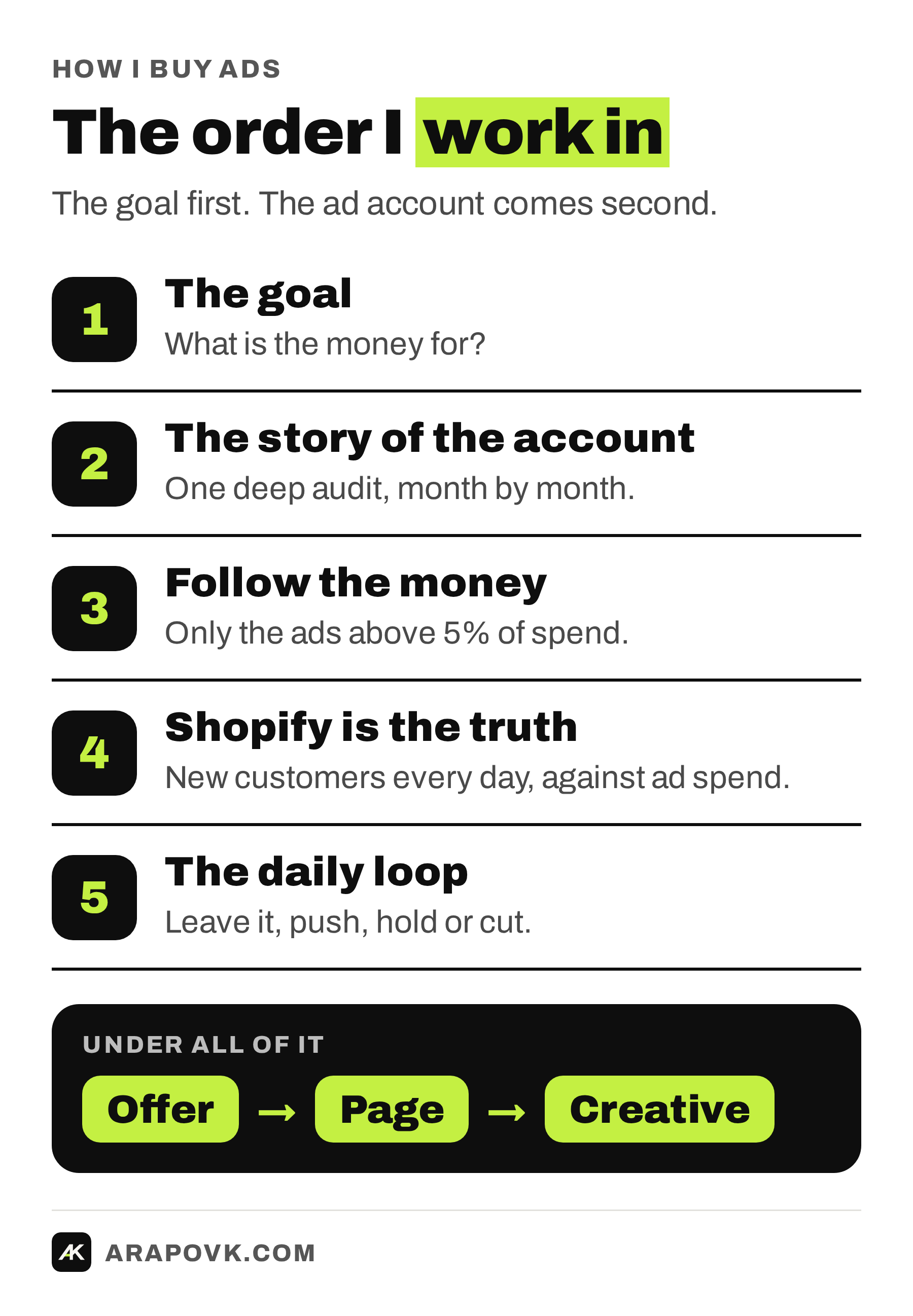
I start with the goal of the business. The ad account comes second.
I do one deep audit, so I know the story of the account. After that I mostly look at where the money goes, and I keep the account simple and boring. That way, when I spend more, I can see what’s working.
Every morning I look at the same numbers and do one of four things: leave it alone, push, hold or cut.
I judge all of it by the new customers who show up in Shopify. And ads only scale once the offer and the page are right.
1. Everything starts with the goal
Before I touch anything, I agree on the goal with the founder. What is the money for?
- selling the company
- raising money
- more profit
- more revenue
- cash for stock or a new warehouse
Each one leads to different decisions. Without a goal, I won’t optimize anything. On one of those calls I said: “I cannot optimize the account because it’s just optimizing for the sake of optimizing something.”
For me, scale means more money or more cash flow for the business. Ad spend is just the tool I use to get there.
Growth doesn’t always have to be profitable either. It depends on where the company is. If the goal is to grow fast, my first question is if there’s cash in the bank to pay for it.
Everything I set later comes from the goal: how hard I push and cut, and even how Meta counts its sales (more on that below). When the goal changes, I change the settings with it.
2. Learn the story of the account, once
When I take over an account, I do one deep audit. Same as an AI agent, I need context first.
I go month by month: what ran (ads, campaigns, pages, offers) and what came back. Once I write it out, I have the story of the account. These months were testing. This is where the right offer showed up. From this month on, it made money.
After that first audit the work gets a lot easier, because from then on I control what gets tested.
The audit always goes in the same order:
- The goal.
- The setup: a simple structure, clear names, links you can track.
- The signals: does the website send Meta clean data?
- Only then the numbers, month by month.
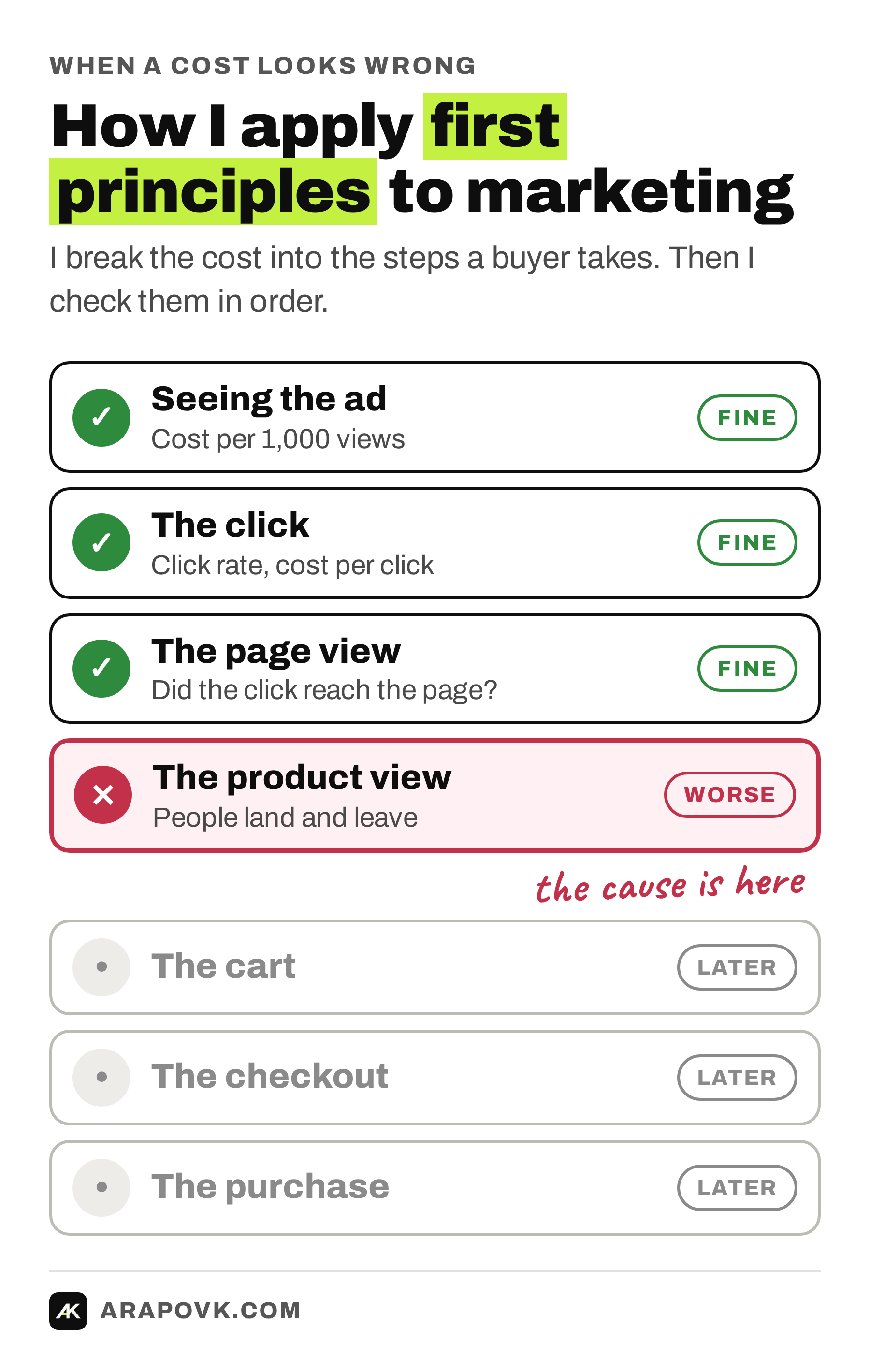
Here is how I apply first-principles thinking to marketing.
When a cost looks wrong, I break it down into the steps a buyer takes: seeing the ad, the click, the page view, the product view, the cart, the checkout and the purchase. I check them one by one, in order. The first step that got worse is where the problem is, so that’s where I look for the cause.
I also look outside the account: the season, the holidays, the economy. If you’re selling bikinis in the winter, it doesn’t matter what angle or KPI you test. It will fail.
I wrote up the audit side in more detail here: the 3-layer Meta audit framework.
3. Follow the money
My first rule when I analyze an account is volume.
Most tools, and most AI, will praise the ad that spent 5 bucks at a crazy return. Meanwhile the account spent a million dollars somewhere else, and nobody looks there.
So I start with the total spend over the last 1 to 3 months, with no breakdowns. That’s my baseline for everything else.
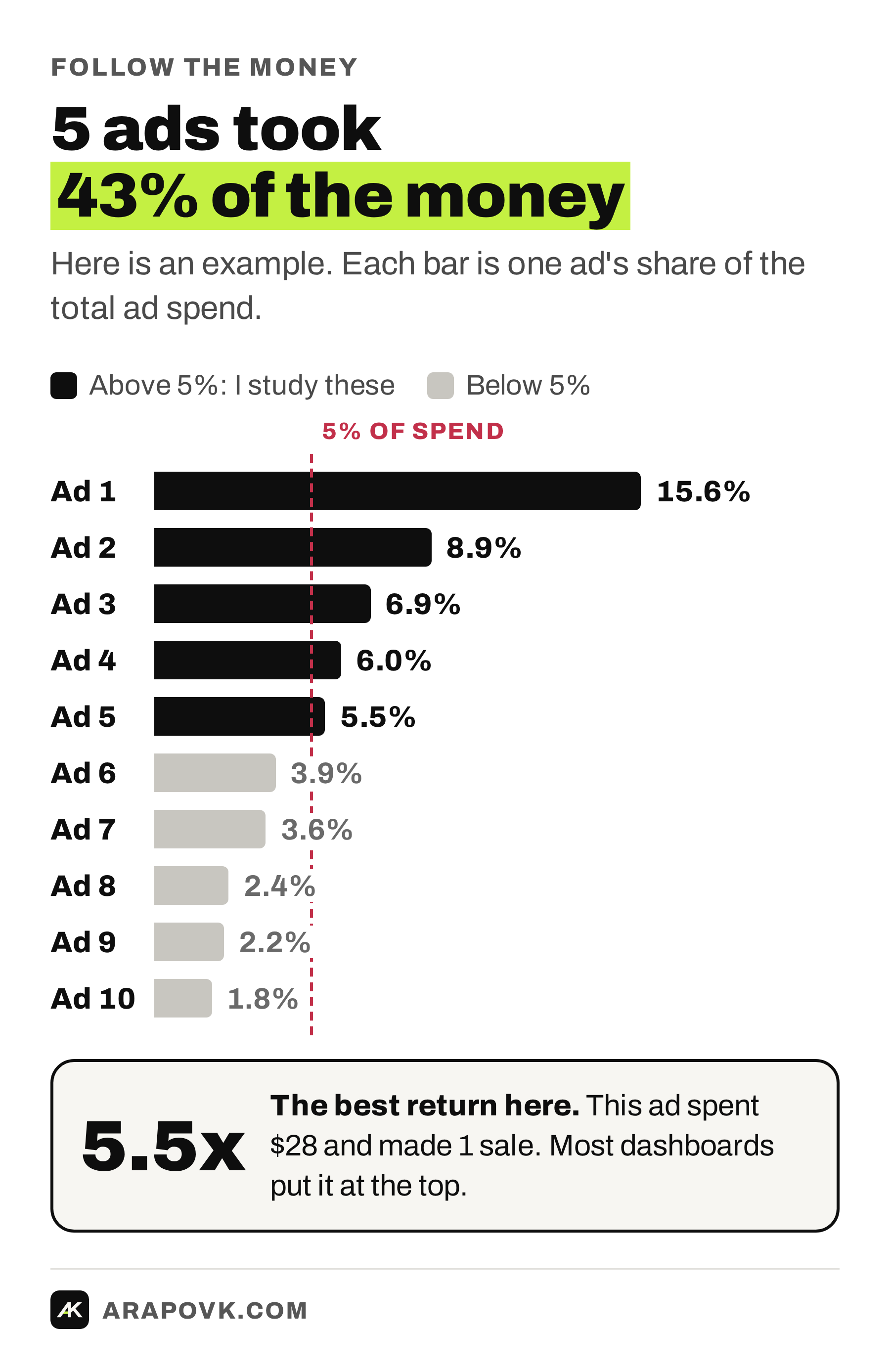
Then I add up each ad across every campaign it runs in. One ad spread over a few campaigns can easily be a fifth of your budget.
I only study the ads that took more than 5% of the total spend.
Here is an example.
I think in ratios before exact numbers. If spend went up, revenue should go up too. That’s the first thing I check.
Every signal is a guess until I verify it. If a person decided where the money went, that tells me about their bias. If Meta’s algorithm decided, that tells me about real demand.
So the goal is to trim the fat and increase the winner.
4. Shopify is the truth
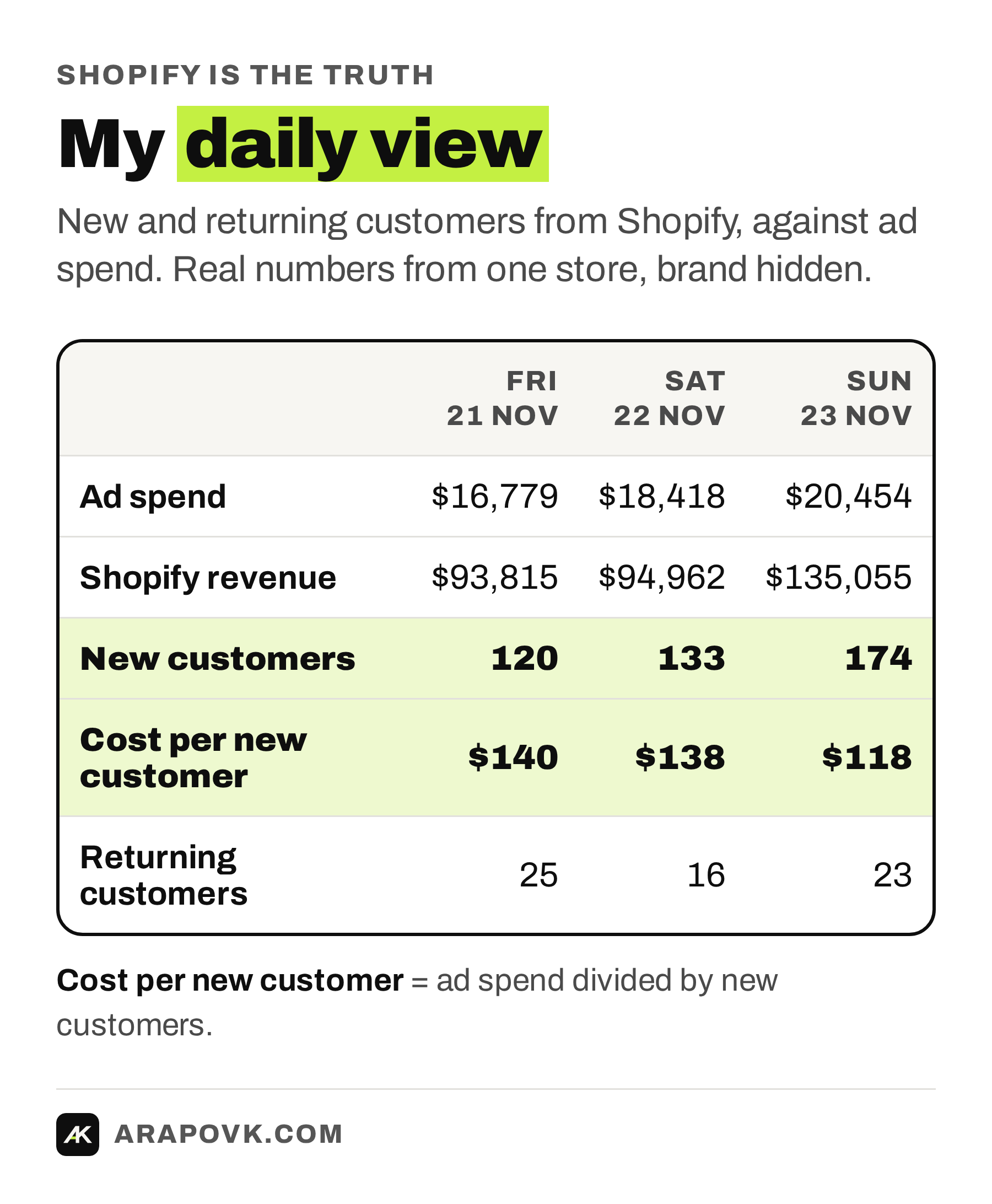
My daily view is simple. I want to know how many new customers and how many returning customers we sold each day in Shopify, against what we spent on ads.
From that I get one number: what it costs to win a new customer, for the whole store. Then I watch if the share of new customers grows.
For the health of the business I use three checks:
- Ad spend as a share of revenue. Around 20 to 30% is healthy, and 20% is the gold range. At 50%, you’re betting the whole business on marketing.
- Profit after product, delivery and ads, as a brake. One client gave me their own rule for it: above 15% of sales, scale hard. Above 11%, spend with care.
- The blunt one: if you switched off the ads tomorrow, how much would you still sell?
To find where the money should go, I compare each product’s share of revenue with its share of ad spend. I also check that the products with the best margins get enough of the ads.
Almost nobody watches the bots. Shopify counts bot visits in its conversion rate. In one store, the month with the worst conversion rate was the month with the most bot traffic. More bots make your store look worse than it is, and they tell you Meta is sending you poor traffic.
5. New customers, without Meta’s breakdown
On one call my friend hit a wall. Meta doesn’t give you a clean split between new, engaged and existing customers for each campaign. His worry was that without it, you never know the real cost of a new customer.
I skip Meta’s split anyway. I take it with a grain of salt.
I use the same numbers as above: the spend from Meta, the new and returning customers from Shopify (where the real orders are), and one cost per new customer for the whole store. Then I watch the share of new customers every day, week and month.
Counting new customers per campaign is too shaky. iPhone tracking breaks it, and people see a few ads before they buy.
To judge one campaign, I look at two other things: how often the same people see its ads, and how its sales right after a click compare with its sales a few days later.
And don’t trust Meta’s “new audience” label. In one account I checked, the new audience had a frequency of 1.4. So those “new” people had already seen the ads more than once, on average.
My test for all of this:
- Write down the share of Shopify revenue that came from new customers last month.
- Switch Meta to count only sales within 1 day of a click, and run it like that for a month.
- If the share grew, the money is reaching new customers and the business is moving toward its goal.
When we got to the end of that test on the call, I said: “It’s so simple.”
6. The click window does two jobs
The click window is how long after an ad Meta can still claim a sale as its own. That can be 1 day after a click, 7 days after a click, or even after someone only saw the ad.
It does two jobs, and most people only think about the first one:
- It decides which sales Meta claims.
- It decides which buyers Meta learns to look for.
The problem is the sales from people who only saw an ad. Someone sees your ad, doesn’t click, comes back later through Google or an email, and buys. Meta still claims that sale. Worse, it learns to show more ads to people like that, and a lot of them are past customers who would have bought anyway.
So Meta looks very good on paper… and Shopify shows 100k, 100k, 100k, every month.
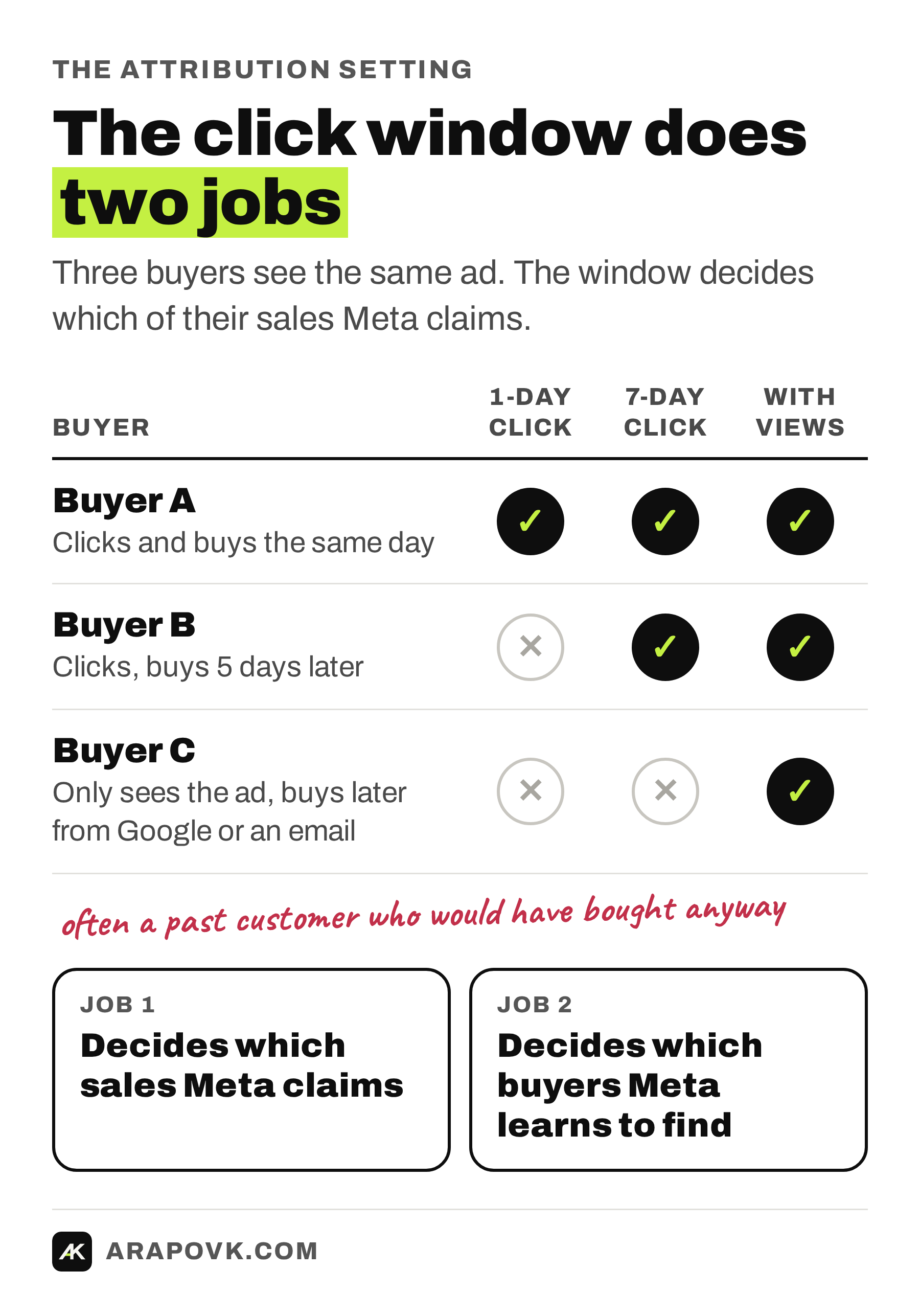
When the goal is new customers, I count clicks only, and I keep past buyers and email lists out of the ads for new people. The sales from people who only saw an ad are noise. Cut the noise and let the algorithm cook.
But Meta needs enough sales inside the window to learn, about 50 per campaign. The shorter the window, the fewer sales it counts. So I decide campaign by campaign:
- A small campaign keeps the wider window, views included, so Meta has enough to learn from.
- A bigger one moves to 7 days of clicks.
- A very big one moves to 1 day of clicks.
So how much data Meta needs depends on the window you pick, on top of its learning phase. My friend didn’t expect that one.
The goal decides the rest. To grow, count clicks. To squeeze profit out of a mature account, count views again, so past buyers keep seeing your other products and stay loyal. Whatever you pick, stick with it for a long time.
Also match the window to how long people take to buy. If people think about your product for days, 1 day of clicks will miss real sales.
On top of the setting, there’s one view I use to read the truth. Meta can count every purchase a person makes, or only their first one.
1 day of clicks, first purchase only, is the most honest number Meta gives you.
Here is an example. In one account I audited, that number showed about $2 back for every $1 of ads. The team was reading 6 to 11.
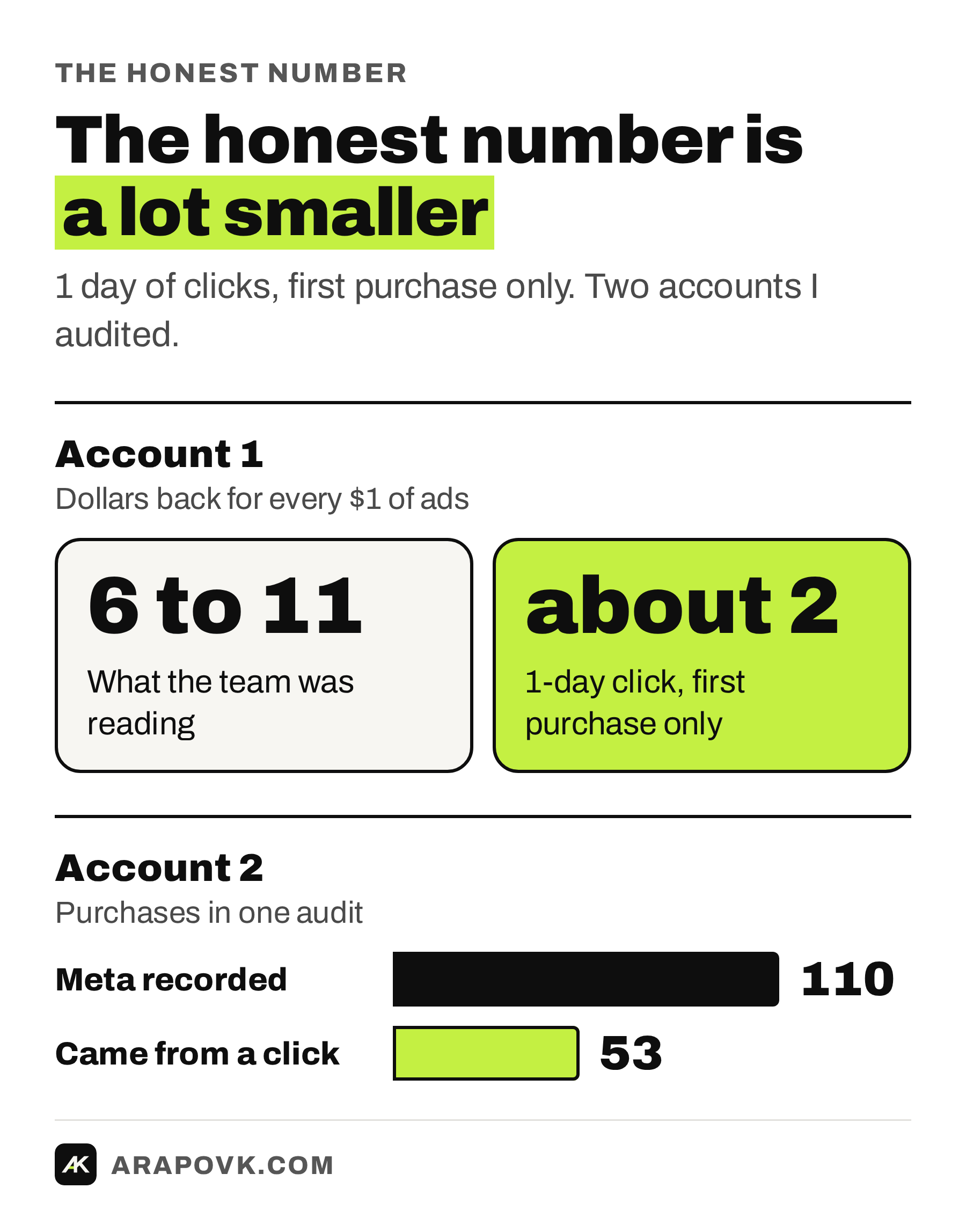
I’ve seen the same gap in smaller accounts. In one audit, Meta recorded 110 purchases, and only 53 of them came from a click.
More on this in your 6x ROAS might actually be a 1x.
7. The daily loop: push, hold, cut
I wake up. I see three numbers. They’re numbers for the whole business, and I only look at campaigns and ads after them.
- Green: I do nothing that day.
- Very green: I first find out why. Then I scale fast.
- Orange: I hold, fix and trim.
- Red: I cut back.
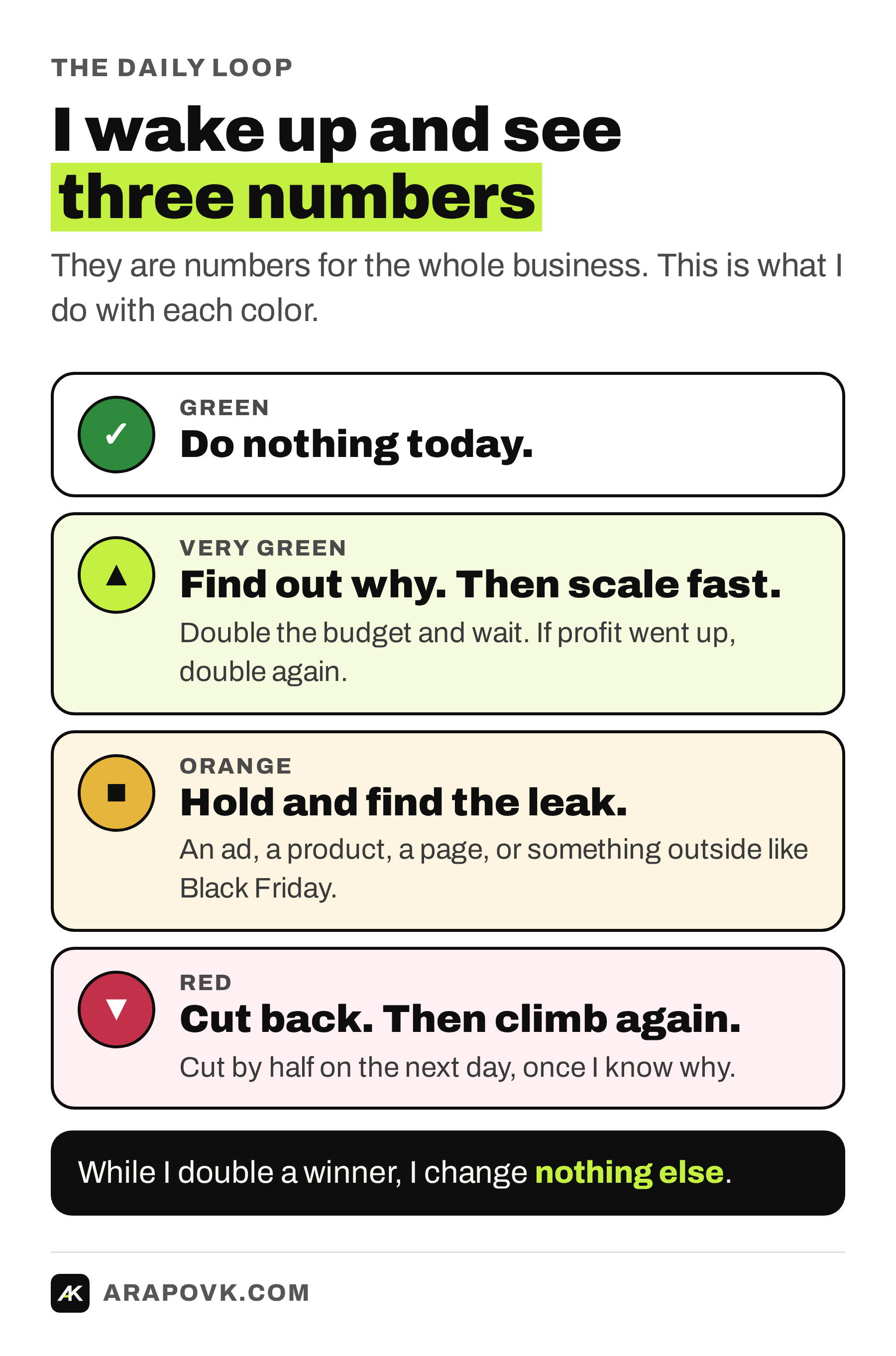
On a proven winner my method is almost mechanical.
Double the budget. Wait. If profit went up, double it again.
In between I don’t add new ads and I don’t touch the structure. “Just push one button. Increase ad spend, that’s it.”
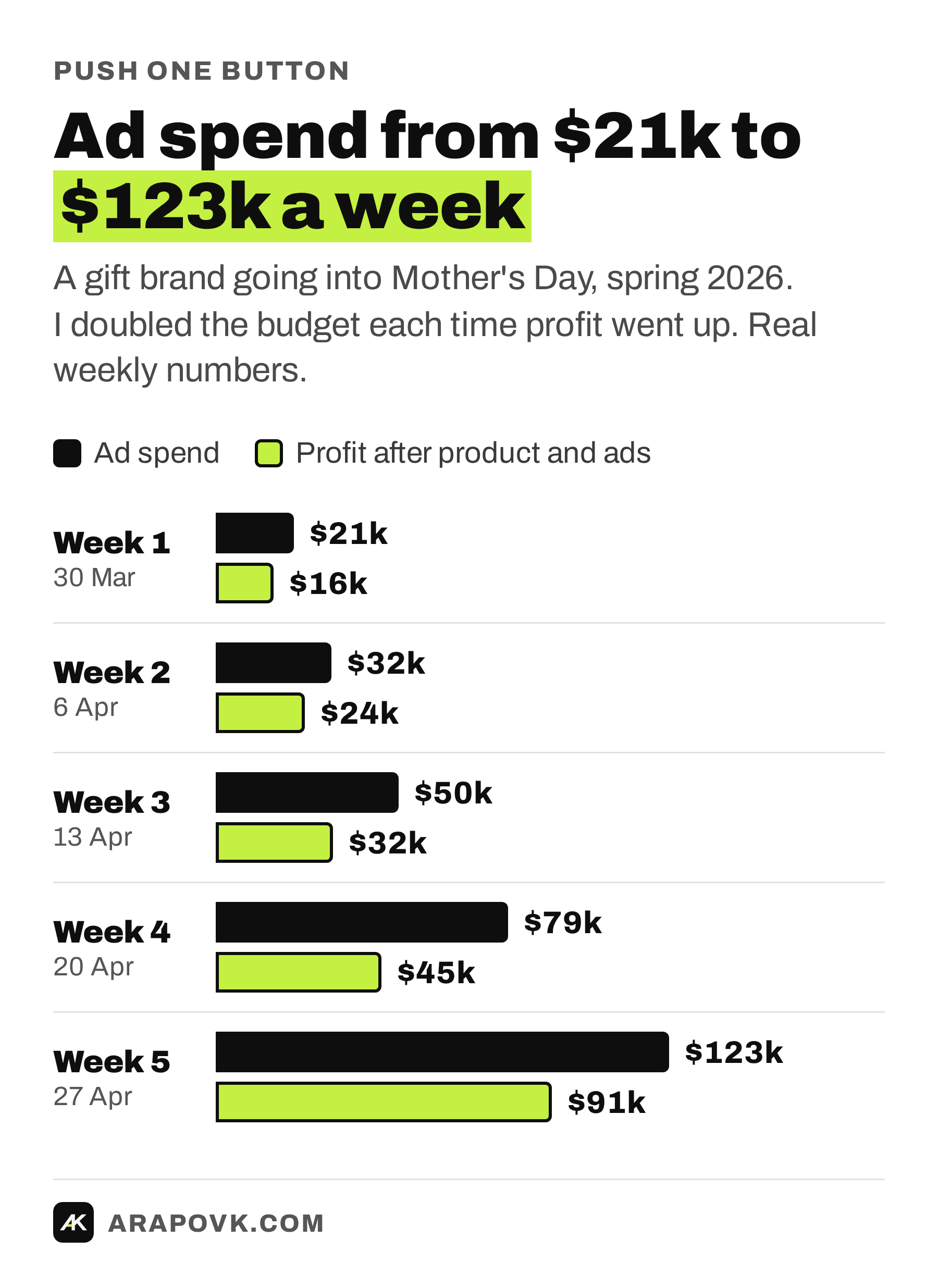
How long I wait depends on how fast people buy. For a gift brand before a holiday, one day was enough. In other accounts I double every Monday. Sometimes I double for a month, touch nothing, and then read what the extra spend brought.
This spring I did that for a gift brand going into Mother’s Day. Weekly ad spend went 21k, 32k, 50k, 79k, 123k. Profit after product and ads went from 16k to 91k a week. I wrote that one up here: I just want to make my money man…
When the numbers stop holding, I keep the spend where it is and look for the leak. It can be an ad, a product, a page, or something outside the account, like Black Friday or Mother’s Day.
When they break, I cut back step by step until it works again, and then I climb again. After a bad day I cut by half, but on the next day, never the same day, and only once I know why. I don’t want to be reactive.
I ride seasons the same way. I squeeze a good window of a few weeks and hold flat when it runs dry. The account stays profitable the whole time. The only question is how much volume we get.
A single ad that loses money can stay on if the account as a whole makes money.
At high spend, the limits move. They stop being the ad account and become the creatives, the team and the back office. If you scale the ads, you have to scale the operations too, or the business breaks behind them.
8. Keep the account simple and boring
Even a big account I’d run with 5 or 6 campaigns at most: budgets set per campaign, catalog ads, simple landing pages and the best ads.
I love it simple and boring, and the reason is practical. When I double the budget, I want to know what’s working.
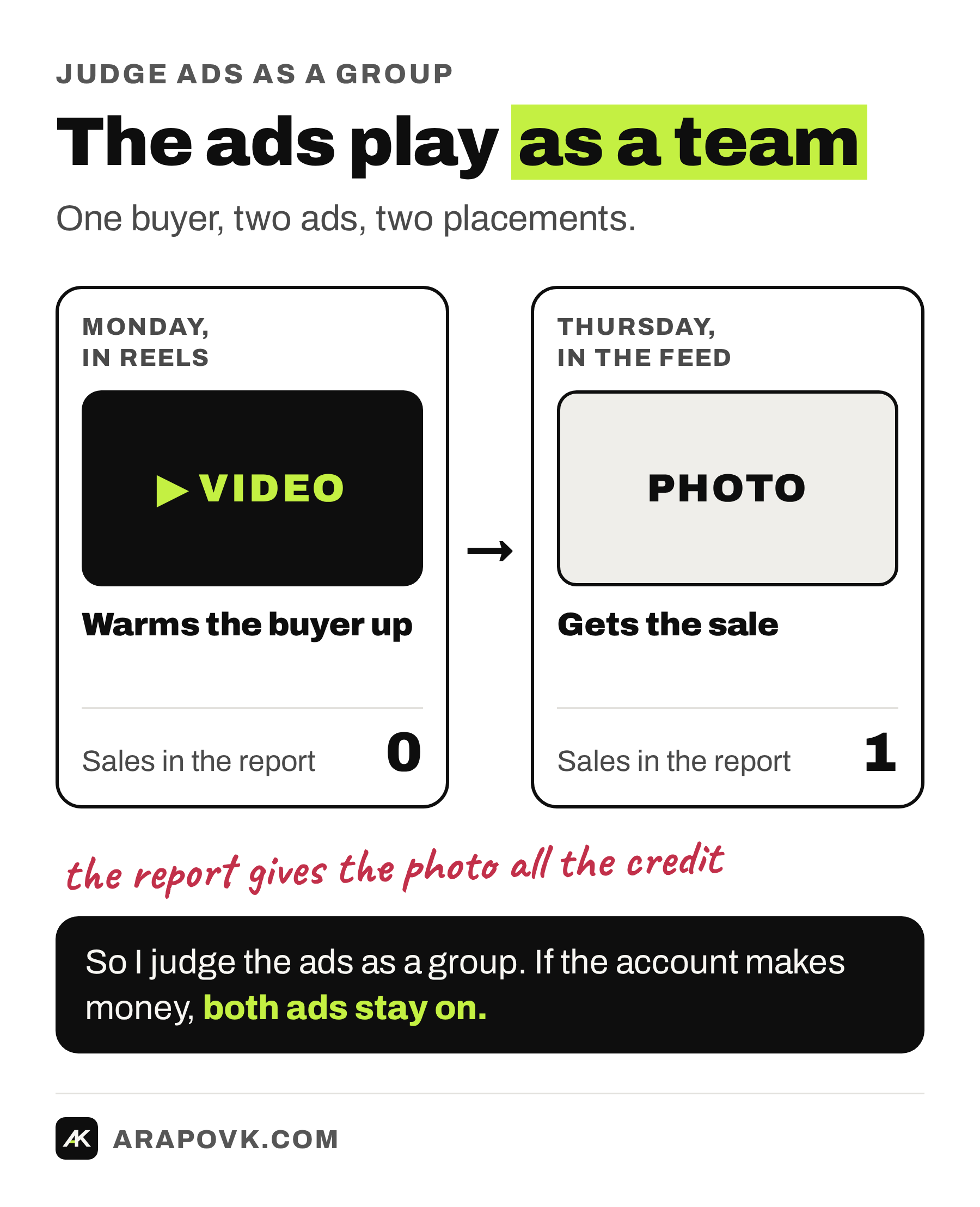
I judge ads as a group, because the ads play as a team. A video can show zero sales because it warmed up the buyer, who then bought from a photo on another placement. If you only look at the report, you’ll say your photos rock and your videos suck.
Every ad gets a clear name, so I can add up the same ad everywhere it runs.
I also watch for the small things that kill reach:
- a few shops running through one ad account
- words in your links that look like a banned product (a “kill” in a product link can make Meta wonder if you sell guns)
- a health word in your domain name
9. Pay more for better customers
I don’t penny pinch. To reach a big goal fast, a brand has to buy more customers at a higher cost. It’s basic math: whoever spends more will win.
That only works if you know what a customer is worth.
So before any optimizing I ask one question: what was the first product your best customers bought, and what did they buy after that?
That first product is the door to your best customers. It also tells you how much you can pay for each one. If I’m paying 500 bucks for a customer who brings me 10,000 over 5 or 10 years, I’m happy.
My rules of thumb:
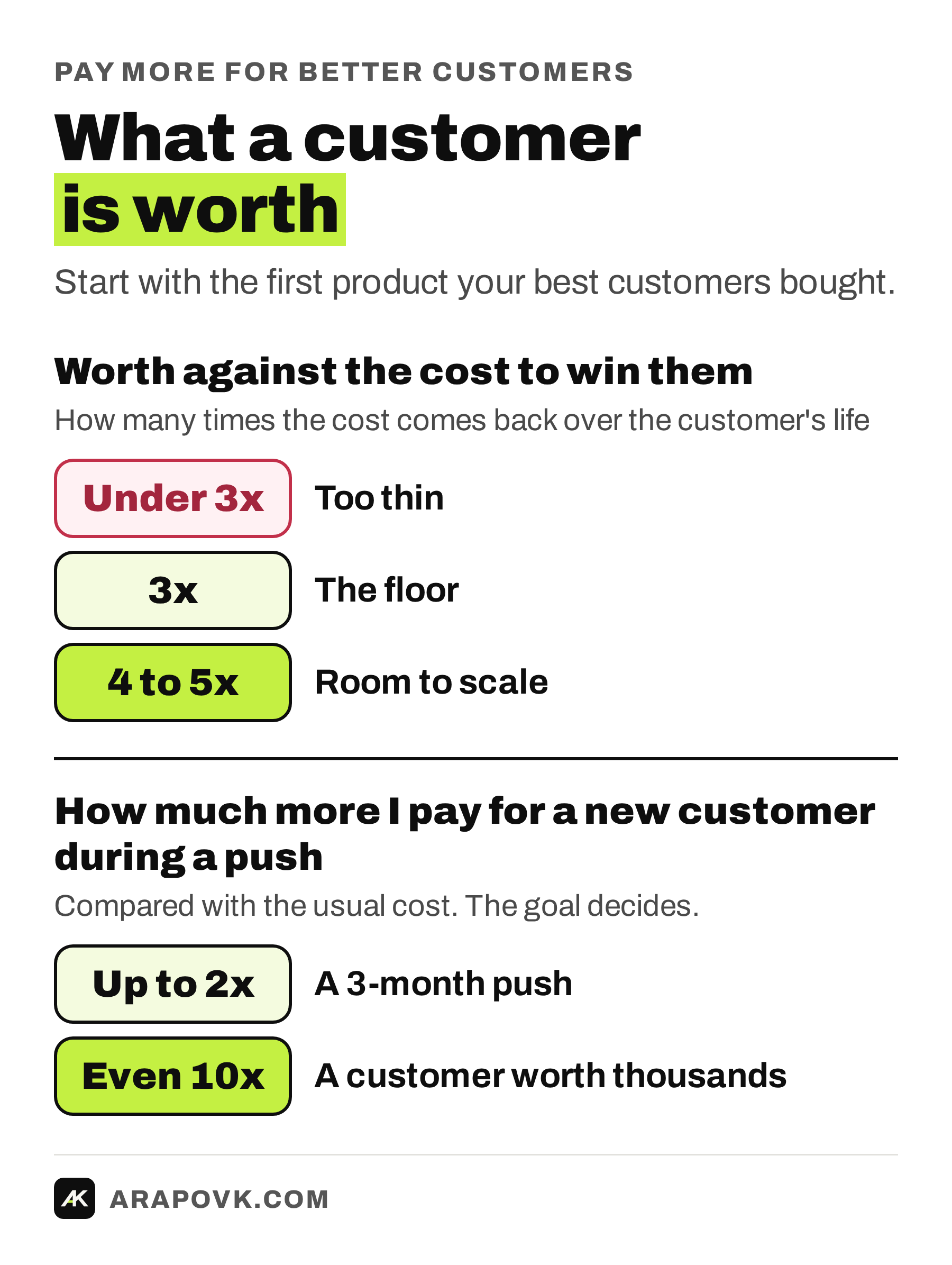
- A customer should be worth at least 3 times what it cost to win them.
- For a business that wants to scale, 4 to 5 times.
- How much more you can pay for a new customer during a push depends on the goal. For one 3-month push I set the line at double the usual cost. For a customer worth thousands, even 10 times the usual cost can be the right call.
I expect the money to come back over 6 months to a year. Returns drop first. Everybody freaks out and switches off the ads, and that’s the mistake.
A product that loses money can still be worth advertising if it’s the door that brings your best customers in. In general I’m happy to break even on the first sale, because the profit comes after, from add-ons, upsells and repeat orders.
I also leave room in the profit per customer, because a thin margin disappears as spend grows. And if you can make the product and the delivery cheaper, that takes pressure off marketing, because ad costs only ever go up.
10. How I test
I test every idea without bias, read the result and move on. I change one thing at a time and then leave it alone.
I decide what I want to learn before I set the test budget. I learn the message cheaply first, then the page, then what Meta should optimize for.
My favorite test for a big account: put all the ad spend on one product for 2 to 3 weeks and watch total revenue. If it doesn’t go up, go back to a split, say 60% on the first product and 40% on the second, and drop the rest.
For new products, I test each one with cheap ads and rank the winners before I buy stock.
For new ideas I ship the smallest version that can sell. The test ends when it makes its first money or when I drop the idea. 1 or 2 weeks of focus is enough to decide.
My own weakness, since we’re being honest: I tend to test too many things at once. I can test 5 things together, put 2k, 3k, 5k into it, and learn nothing.
11. Offer first, then the page, then the creative
When I wrote up one of my best results, the order was clear. A solid offer and a good funnel made the scaling possible, and the creatives came after.
The offer comes first. I copy what the market already does (bundles, a reference price, a guarantee) and only then look for a niche. I lock the offer before I write the page or the ads.
The offer and the strategy stay my job. I use agents to design and build, and I make the call. My own agent once priced a product way above the market, which is exactly why I don’t let it make the money decisions.
Then the page. For a new brand, an ad straight to a product page will most likely fail. A selling article or a list page in between works better. In one launch I put up an advertorial and a listicle, and it started working right away. I copy page layouts that already work.
Then the creative. For me, making the ads and buying them is one job. Once the hero product is clear, every angle goes on it, and the emails and upsells do the rest. Creative is the ceiling on how much a brand can spend. I take good ads apart to brief new ones, and I keep the creative varied, because an agent that only sees past winners makes the same angle over and over.
AI is great at the execution, but copy that sells still needs me steering it.
12. What I ignore
A big part of keeping it simple is what I don’t look at:
- Small spenders, however good they look.
- Meta’s own purchase count, and the sales it claims from people who only saw an ad, when I make growth decisions.
- The numbers of single ads while I’m doubling a winner.
- An expensive click on a campaign that makes money. In that spring run, Google clicks cost about $7 each. Do I care? It was printing money.
- Ad spend as a share of revenue on its own. A great ratio can come from sending 110 emails that month while the ads grow nothing.
- The panic when honest numbers make Meta look bad, as long as Shopify keeps growing.
13. The mistakes I keep seeing in bigger accounts
I see the same things in brand after brand:
- Too many products and too many buttons. 2 or 3 hero products usually bring most of the other sales.
- Chasing a very high return inside Meta. The team trims exactly the ads that bring in fresh customers. I watched one account sit at the same spend for about 6 months like that.
- Too much activity. Uploading, testing, switching ads off in the morning and again at night, changing offers.
- Being too tight with spend for the size of the goal.
- Ads carrying everything. A brand that size should be able to survive a while without ads.
If it were my business, I’d run the one-product test and have way fewer people touching the ads.
To be fair, this is also about risk. I’ll double a budget to see where it breaks, and a more careful buyer won’t. Both can be right. It depends on the goal and the cash.
14. If you want an AI agent to do this
This is the order I’d give an agent:
- Get the goal from the founder and check the cash.
- Do one deep audit that writes the story of the account, and keep that story up to date.
- Read Shopify: new and returning customers, revenue and spend by product, bot visits.
- Find the first product of the best customers.
- Put the money on the winners and keep the account simple.
- Run the daily loop of three numbers.
- Watch the numbers at every level, from the whole business down to single ads.
- Work on creative strategy after all of that.
I already run my own agents like this. After about a week of setup, an agent sends me a daily report. I read it, approve the next round, and the agent makes the new ads. Good enough for me is about 90%, so most of my job is approving.
Pushing the buttons is easy. The hard part is knowing what to make.
Two warnings: the exact rules are different for every business, and some accounts I wouldn’t automate at all.
15. Where this can go wrong
My style is bold. Last holiday season I pushed a client too hard. Maybe I got lazy. I had to cut weekly spend from about 220k down to 29k before it was efficient again. Then I climbed again.
My biggest wins were smaller brands with one strong offer. A company with several brands, lots of products, stock limits and slow delivery is harder to steer. Even there I look at the customer across all the brands, because in the end it’s one person buying.
Here’s your stupid-simple, high-ROI insight.
Tomorrow morning, open Shopify before you open Ads Manager. Count yesterday’s new customers, then divide yesterday’s ad spend by that number. Do it every day for a week before you change anything in the account.
If you want me to look at your account this way, see if we’re a good fit.
Talk soon,
Kris
P.S. Want the next breakdown like this in your inbox first? Join the newsletter here.